


总线的I/O扩展器控制LCD偏置电压
液晶电视
1人已加入
描述
Abstract: A circuit consisting of an SMBus™ I/O expander, step-up converter, and digital potentiometer enables the SMBus to control the contrast of an LCD.
Small, handheld, battery-powered devices often feature an LCD panel and a microcontroller with limited I/O pins. The SMBus is useful for controlling system functions under limited I/O and, for convenience, it should also be able to control the LCD contrast. In Figure 1, this task is accomplished with an SMBus I/O expander (IC2), a step-up converter (IC1), and a digital potentiometer (IC3).
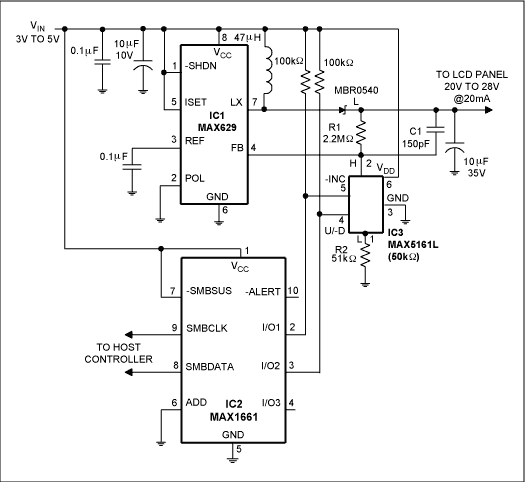
Figure 1. This three-IC circuit enables small battery-powered devices to control their LCD contrast through the internal SMBus.
The SMBus I/O expander was designed to drive high-side MOSFETs in power-management systems, but the bidirectional capability of its three output lines makes it useful in applications unrelated to power-plane switching. Here, for example, it serves to control the wiper position of a digital pot connected in the rheostat configuration. In turn, the rheostat varies IC1's feedback voltage (pin 4) as follows:
Maximum LCD voltage:
1.25V x [(R2 + RPOT-MIN + R1) / (R2 + RPOT-MIN)] = 28.6V,
where RPOT-MIN is the digital pot's minimum resistance (about 400Ω).
Minimum LCD voltage:
1.25V x [(R2 + RPOT-MAX + R1) / (R2 + RPOT-MAX)] = 19.5V,
where RPOT-MAX is the digital pot's maximum resistance (about 50kΩ).
The digital pot's internal wiper moves one step in response to each high-to-low transition at pin 5 (up when pin 4 is high, or down when pin 4 is low). Thus, while controlling pin 4, the host controller decrements the pot by writing the sequence xFF, xFE, xFF to the address x40, and increments the pot by writing xFD, xFC, xFD to the same address.
IC3's rheostat connection can assume 32 levels of resistance between its maximum and minimum values. Its linear taper produces some variation in those step sizes—at the FB terminal of IC1, steps near the minimum voltage are about 0.2V, and steps near the maximum are about 0.44V.
A large departure from the resistor values shown may require a different value of the compensation capacitor (C1) to maintain stability.
A similar version of this article appeared in the ~July-August 2000 issue of Electronic Design magazine.
打开APP阅读更多精彩内容
Small, handheld, battery-powered devices often feature an LCD panel and a microcontroller with limited I/O pins. The SMBus is useful for controlling system functions under limited I/O and, for convenience, it should also be able to control the LCD contrast. In Figure 1, this task is accomplished with an SMBus I/O expander (IC2), a step-up converter (IC1), and a digital potentiometer (IC3).
Figure 1. This three-IC circuit enables small battery-powered devices to control their LCD contrast through the internal SMBus.
The SMBus I/O expander was designed to drive high-side MOSFETs in power-management systems, but the bidirectional capability of its three output lines makes it useful in applications unrelated to power-plane switching. Here, for example, it serves to control the wiper position of a digital pot connected in the rheostat configuration. In turn, the rheostat varies IC1's feedback voltage (pin 4) as follows:
Maximum LCD voltage:
1.25V x [(R2 + RPOT-MIN + R1) / (R2 + RPOT-MIN)] = 28.6V,
where RPOT-MIN is the digital pot's minimum resistance (about 400Ω).
Minimum LCD voltage:
1.25V x [(R2 + RPOT-MAX + R1) / (R2 + RPOT-MAX)] = 19.5V,
where RPOT-MAX is the digital pot's maximum resistance (about 50kΩ).
The digital pot's internal wiper moves one step in response to each high-to-low transition at pin 5 (up when pin 4 is high, or down when pin 4 is low). Thus, while controlling pin 4, the host controller decrements the pot by writing the sequence xFF, xFE, xFF to the address x40, and increments the pot by writing xFD, xFC, xFD to the same address.
IC3's rheostat connection can assume 32 levels of resistance between its maximum and minimum values. Its linear taper produces some variation in those step sizes—at the FB terminal of IC1, steps near the minimum voltage are about 0.2V, and steps near the maximum are about 0.44V.
A large departure from the resistor values shown may require a different value of the compensation capacitor (C1) to maintain stability.
A similar version of this article appeared in the ~July-August 2000 issue of Electronic Design magazine.
声明:本文内容及配图由入驻作者撰写或者入驻合作网站授权转载。文章观点仅代表作者本人,不代表电子发烧友网立场。文章及其配图仅供工程师学习之用,如有内容侵权或者其他违规问题,请联系本站处理。
举报投诉
-
SGM4594:低电压16位I²C和SMBus低功耗I/O扩展器的全面解析2026-03-17 563
-
SGM4591:低电压16位I²C和SMBus低功耗I/O扩展器的深度解析2026-03-16 526
-
深入解析PCF8574:I²C总线8位I/O扩展器的设计与应用2025-12-30 1444
-
TCA9555:低电压16位I²C和SMBus I/O扩展器的全面解析2025-12-25 911
-
TCA6424A:低电压24位I²C和SMBus I/O扩展器的深度解析2025-12-24 567
-
TCAL9539:低电压转换、16 位 I2C 总线、SMBus I/O 扩展器的设计指南2025-12-16 607
-
TCAL9539 I2C总线I/O扩展器技术解析与应用指南2025-08-08 1675
-
SMBus I/O扩展器控制LCD偏置电压2023-01-10 2389
-
上电和复位 16 位 PCA I2C 总线 I/O 扩展器2022-11-15 1360
-
ADP5587:移动I/O扩展器和QWERTY键盘控制器产品手册2021-05-12 857
-
AN070231 I O扩展器选型指南2009-11-03 494
全部0条评论

快来发表一下你的评论吧 !
