


Legacy T1/E1 8MHz Backplane Op
通信设计应用
65人已加入
描述
Abstract: This application note provides the requirements for multiplexing four PCM streams into one 8MHz system backplane using Dallas Semiconductor/Maxim SCTs and framers that do not contain interleave bus operation (IBO) modes internally.The DS2155, DS26528, DS26524, DS26522, DS26521, DS26519 and DS26518 all contain IBO functionality without external circuitry and are recommended for new designs.
This application note will discuss the requirements for multiplexing four PCM streams into one 8MHz system backplane using Dallas Semiconductor SCTs and framers that do not contain interleave bus operation (IBO) functionality internally. > The DS2155, DS26528, DS26524, DS26522, DS26521, DS26519 and DS26518 all contain IBO functionality internally and do not need the extra logic shown below.
T1 or E1 PCM signals can interface to an 8MHz system backplane. Typically, this application is used to multiplex four PCM streams onto a single 8MHz PCM stream. To accomplish this, the elastic stores are enabled and placed in the 2.048MHz SYSCLK mode. Figure 1 illustrates a circuit in which a single SYNC signal is generated for all four framers. Each framer in turn is driven with an 8.192MHz clock burst of 8 cycles. Each clock burst causes the elastic store to output one DS0. This results in a byte-interleaved 8.192MHz PCM steam (see Figure 2).
Figures 1 and 2 apply to the DS2152 and DS2154. Figure 1 shows the 8.192MHz clock can optionally be derived from a master DS2152/54.
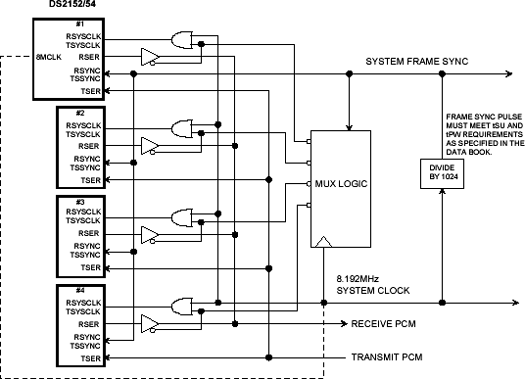
Figure 1.
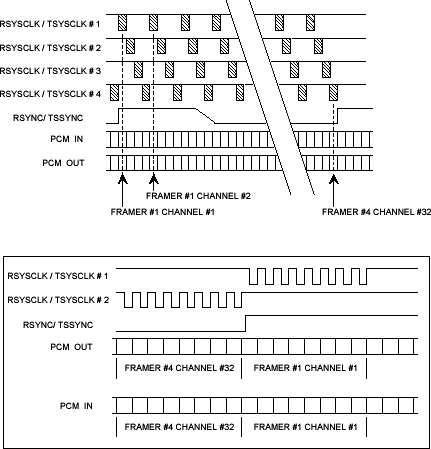
Figure 2.
Figures 3 and 4 apply to the DS2141, DS21Q41, DS2143, DS21Q43, DS2151, and DS2153.
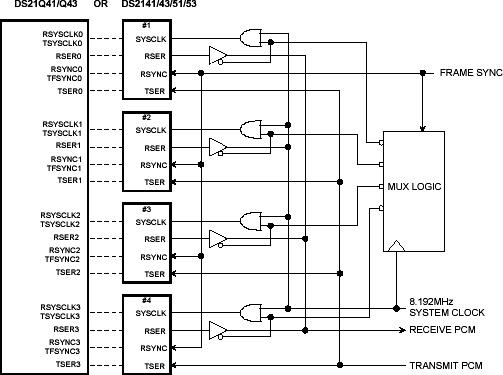
Figure 3.
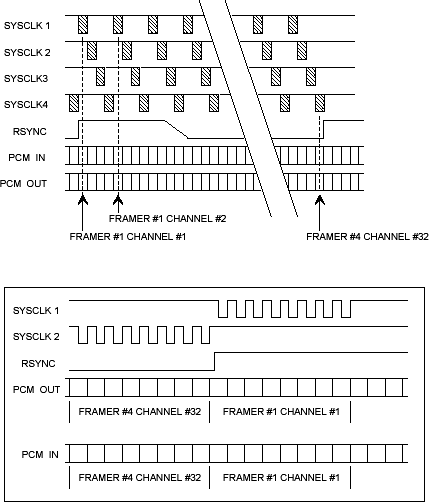
Figure 4.
For more information about our legacy T1/E1 products, please consult the data sheets available on our website at www.maxim-ic.com/telecom.
打开APP阅读更多精彩内容
Introduction
This application note applies to the following products:| T1 Framers | E1 Framers | T1 SCTs | E1 SCTs |
| DS2141A | DS2143 | DS2151 | DS2153 |
| DS21Q41B | DS21Q43A | DS2152 | DS2154 |
This application note will discuss the requirements for multiplexing four PCM streams into one 8MHz system backplane using Dallas Semiconductor SCTs and framers that do not contain interleave bus operation (IBO) functionality internally. > The DS2155, DS26528, DS26524, DS26522, DS26521, DS26519 and DS26518 all contain IBO functionality internally and do not need the extra logic shown below.
T1 or E1 PCM signals can interface to an 8MHz system backplane. Typically, this application is used to multiplex four PCM streams onto a single 8MHz PCM stream. To accomplish this, the elastic stores are enabled and placed in the 2.048MHz SYSCLK mode. Figure 1 illustrates a circuit in which a single SYNC signal is generated for all four framers. Each framer in turn is driven with an 8.192MHz clock burst of 8 cycles. Each clock burst causes the elastic store to output one DS0. This results in a byte-interleaved 8.192MHz PCM steam (see Figure 2).
Figures 1 and 2 apply to the DS2152 and DS2154. Figure 1 shows the 8.192MHz clock can optionally be derived from a master DS2152/54.
Figure 1.
Figure 2.
Master Clock Source
In Figure 1, the 8.192MHz system clock may be derived from a T1/E1 line as indicated by the dotted line. This line becomes the timing master for the other three devices. In this example, device #1 is used as the master. The other three devices may experience frame slips since there is no guarantee that their inbound T1/E1 rates are synchronous to device #1's inbound rate. The elastic stores manage frame slip events in a logical manner by either repeating or deleting a full frame.Master Clock Failure
In the event that the master line fails, the following events will occur. RCLK will be replaced by MCLK. If the jitter attenuator is enabled in the receive path, this transition will be very smooth. Consequently, the 8.192MHz clock output on the 8 MCLK pin will make a slight and smooth transition to be phase locked to the clock at MCLK. The 8.192MHz system timing will not experience any disturbance of the byte interleave structure. Device #1 will report a receive carrier loss (RCL) event via the status registers. When the host detects the failure of the master line, processor selection logic may be used to switch to another active line.Figures 3 and 4 apply to the DS2141, DS21Q41, DS2143, DS21Q43, DS2151, and DS2153.
Figure 3.
Figure 4.
Backplane Information
If you have further questions on backplane operation of our legacy T1/E1 products, please contact the Telecommunication Applications support team via email telecom.support@dalsemi.com or call 972-371-6555.For more information about our legacy T1/E1 products, please consult the data sheets available on our website at www.maxim-ic.com/telecom.
声明:本文内容及配图由入驻作者撰写或者入驻合作网站授权转载。文章观点仅代表作者本人,不代表电子发烧友网立场。文章及其配图仅供工程师学习之用,如有内容侵权或者其他违规问题,请联系本站处理。
举报投诉
- 相关推荐
- 热点推荐
- E1
-
ZL30100 T1/E1系统同步器:功能特性与应用解析2026-04-15 204
-
MAX4670:T1/E1/J1线路冗余保护的理想之选2026-04-03 240
-
T1和E1之间的转换2023-01-10 3242
-
DS26324 E1/T1/J1系统端口短程线路接口单元2011-03-22 2733
-
T1/E1 Frame Processor Agilent2010-07-09 705
-
什么是T1与E1线路2010-03-19 7848
-
E1(T1)保护电路及方案2009-11-20 2950
-
DS2152 and DS2154 8MHz System2009-04-29 1319
-
DS31256 and T1/E1 Interface2009-04-20 1880
全部0条评论

快来发表一下你的评论吧 !
