


【S32K146 RT-thread】基于内部PFLASH的littlefs适配
描述
LittleFS是一个应用于单片机内部flash和外挂NOR flash的文件系统。由于它相比传统的FAT文件系统更适合于小型嵌入式系统,具有以下特点:
掉电恢复能力: 设计用于处理随机电源故障。所有文件操作都有很强的写时拷贝保证,如果断电,文件系统将恢复到上一次已知的良好状态。
动态磨损均衡: 设计考虑到闪存,并提供动态块磨损均衡。此外,littlefs可以检测坏块并在它们周围工作。
有限RAM/ROM: 被设计为使用少量内存。RAM的使用是严格限制的,这意味着RAM的使用不会随着文件系统的增长而改变。文件系统不包含无界递归,动态内存仅限于可静态提供的可配置缓冲区。
官方的详细介绍参照此链接(https://github.com/littlefs-project/littlefs/)
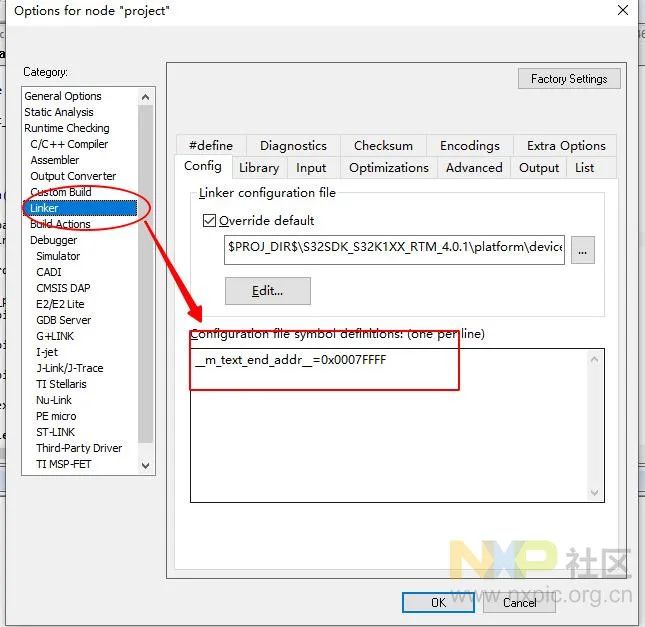
S32K146 内部的Pflash 资源大小为1M,这个大小对普通的嵌入式开发资源是有很大的空闲的,本次试验基于内部的pflash 将后512K资源划分为文件系统分区,使用littlefs 进行管理,我们修改链接脚本把后512K资源保留出来给文件系统使用,本次试验使用的IAR环境,link file 修改如下:

littlefs 移植适配依赖物理层的配置结构体如下:
// Configuration provided during initialization of the littlefsstruct lfs_config { // Opaque user provided context that can be used to pass // information to the block device operations void *context;
// Read a region in a block. Negative error codes are propagated // to the user. int (*read)(const struct lfs_config *c, lfs_block_t block, lfs_off_t off, void *buffer, lfs_size_t size);
// Program a region in a block. The block must have previously // been erased. Negative error codes are propagated to the user. // May return LFS_ERR_CORRUPT if the block should be considered bad. int (*prog)(const struct lfs_config *c, lfs_block_t block, lfs_off_t off, const void *buffer, lfs_size_t size);
// Erase a block. A block must be erased before being programmed. // The state of an erased block is undefined. Negative error codes // are propagated to the user. // May return LFS_ERR_CORRUPT if the block should be considered bad. int (*erase)(const struct lfs_config *c, lfs_block_t block);
// Sync the state of the underlying block device. Negative error codes // are propagated to the user. int (*sync)(const struct lfs_config *c);
#ifdef LFS_THREADSAFE // Lock the underlying block device. Negative error codes // are propagated to the user. int (*lock)(const struct lfs_config *c);
// Unlock the underlying block device. Negative error codes // are propagated to the user. int (*unlock)(const struct lfs_config *c);#endif
// Minimum size of a block read in bytes. All read operations will be a // multiple of this value. lfs_size_t read_size;
// Minimum size of a block program in bytes. All program operations will be // a multiple of this value. lfs_size_t prog_size;
// Size of an erasable block in bytes. This does not impact ram consumption // and may be larger than the physical erase size. However, non-inlined // files take up at minimum one block. Must be a multiple of the read and // program sizes. lfs_size_t block_size;
// Number of erasable blocks on the device. lfs_size_t block_count;
// Number of erase cycles before littlefs evicts metadata logs and moves // the metadata to another block. Suggested values are in the // range 100-1000, with large values having better performance at the cost // of less consistent wear distribution. // // Set to -1 to disable block-level wear-leveling. int32_t block_cycles;
// Size of block caches in bytes. Each cache buffers a portion of a block in // RAM. The littlefs needs a read cache, a program cache, and one additional // cache per file. Larger caches can improve performance by storing more // data and reducing the number of disk accesses. Must be a multiple of the // read and program sizes, and a factor of the block size. lfs_size_t cache_size;
// Size of the lookahead buffer in bytes. A larger lookahead buffer // increases the number of blocks found during an allocation pass. The // lookahead buffer is stored as a compact bitmap, so each byte of RAM // can track 8 blocks. Must be a multiple of 8. lfs_size_t lookahead_size;
// Optional statically allocated read buffer. Must be cache_size. // By default lfs_malloc is used to allocate this buffer. void *read_buffer;
// Optional statically allocated program buffer. Must be cache_size. // By default lfs_malloc is used to allocate this buffer. void *prog_buffer;
// Optional statically allocated lookahead buffer. Must be lookahead_size // and aligned to a 32-bit boundary. By default lfs_malloc is used to // allocate this buffer. void *lookahead_buffer;
// Optional upper limit on length of file names in bytes. No downside for // larger names except the size of the info struct which is controlled by // the LFS_NAME_MAX define. Defaults to LFS_NAME_MAX when zero. Stored in // superblock and must be respected by other littlefs drivers. lfs_size_t name_max;
// Optional upper limit on files in bytes. No downside for larger files // but must be <= LFS_FILE_MAX. Defaults to LFS_FILE_MAX when zero. Stored // in superblock and must be respected by other littlefs drivers. lfs_size_t file_max;
// Optional upper limit on custom attributes in bytes. No downside for // larger attributes size but must be <= LFS_ATTR_MAX. Defaults to // LFS_ATTR_MAX when zero. lfs_size_t attr_max;
// Optional upper limit on total space given to metadata pairs in bytes. On // devices with large blocks (e.g. 128kB) setting this to a low size (2-8kB) // can help bound the metadata compaction time. Must be <= block_size. // Defaults to block_size when zero. lfs_size_t metadata_max;};
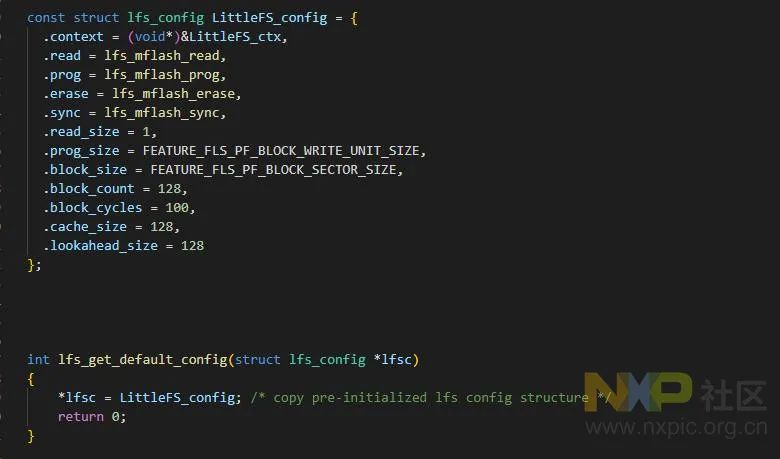
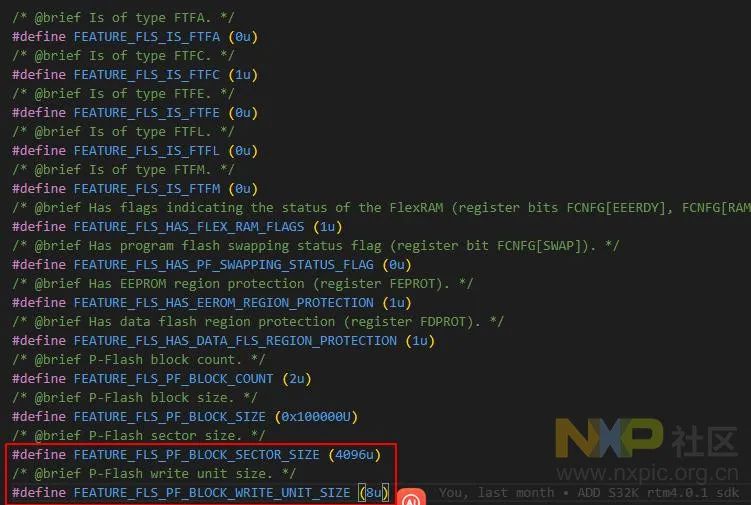
主要包含物理层设备的读写/擦除,及FLASH最小编程块属性配置,查看S32K146 的features 可以知道,最小擦除的sector 为4096字节,最小写操作size 为8字节,我们按照littlefs 依赖的配置结构实现对应的函数。
read 接口实现:
int lfs_mflash_read(const struct lfs_config *lfsc, lfs_block_t block, lfs_off_t off, void *buffer, lfs_size_t size){ struct lfs_mflash_ctx *ctx; uint32_t flash_addr;
assert(lfsc); ctx = (struct lfs_mflash_ctx *)lfsc->context; assert(ctx);
flash_addr = ctx->start_addr + block * lfsc->block_size + off; for(lfs_size_t i=0; i < size; i++) { ((int8_t *)buffer)[i] = *((__IO int8_t*)flash_addr); flash_addr++; }
return LFS_ERR_OK;}
prog接口实现:
int32_t mflash_drv_program(uint32_t addr,uint32_t size,uint8_t * pdata){ status_t ret;
ret = FLASH_DRV_Program(&pSSDConfig,addr,size,pdata);
return ret == STATUS_SUCCESS ? 0 : -1;}
int lfs_mflash_prog( const struct lfs_config *lfsc, lfs_block_t block, lfs_off_t off, const void *buffer, lfs_size_t size){ struct lfs_mflash_ctx *ctx; uint32_t flash_addr; int32_t ret;
ctx = (struct lfs_mflash_ctx *)lfsc->context;
flash_addr = ctx->start_addr + block * lfsc->block_size + off; ret = mflash_drv_program(flash_addr,size,(uint8_t *)buffer); return (ret == 0) ? LFS_ERR_OK : LFS_ERR_IO;}
erase 接口实现;
int32_t mflash_drv_erase(uint32_t dest,uint32_t size)
对应的配置结构如下:
适配接口已经对应完成,littlefs 会依赖动态malloc/free 内存接口,本次是基于RT-thread 系统lfs_util.h需做如下修改:
至此Littfs 依赖的适配接口已经完成,我们追加shell 测试命令来验证littlefs的基本创建删除文件及文件夹及读写删除试验,对应的shell 测试命令代码如下:
#include "drv_mflash.h"#include #include #include #include #include
#define SHELL_Printf rt_kprintf#define PRINTF rt_kprintf
/******************************************************************************* * Variables ******************************************************************************/
lfs_t lfs;struct lfs_config cfg;int lfs_mounted;
static void format(int argc, char **argv){ int res;
if (lfs_mounted) { SHELL_Printf("LFS is mounted, please unmount it first.\r\n"); return; }
if (argc != 2 || strcmp(argv[1], "yes")) { SHELL_Printf("Are you sure? Please issue command "format yes" to proceed.\r\n"); return; }
res = lfs_format(&lfs, &cfg); if (res) { PRINTF("\rError formatting LFS: %d\r\n", res); }
return;}
MSH_CMD_EXPORT(format,"lfs format api");
static void mount(int argc, char **argv){ int res;
if (lfs_mounted) { SHELL_Printf("LFS already mounted\r\n"); return; }
res = lfs_mount(&lfs, &cfg); if (res) { PRINTF("\rError mounting LFS\r\n"); } else { lfs_mounted = 1; }
return;}MSH_CMD_EXPORT(mount,lfs mount api);
static void unmount(int argc, char **argv){ int res;
if (!lfs_mounted) { SHELL_Printf("LFS not mounted\r\n"); return; }
res = lfs_unmount(&lfs); if (res) { PRINTF("\rError unmounting LFS: %i\r\n", res); }
lfs_mounted = 0; return;}MSH_CMD_EXPORT(unmount,lfs unmount api);
static void cd(int argc, char **argv){ SHELL_Printf( "There is no concept of current directory in this example.\r\nPlease always specify the full path.\r\n"); return;}MSH_CMD_EXPORT(cd,lfs cd api);
static void lls(int argc, char **argv){ int res; char *path; lfs_dir_t dir; struct lfs_info info; int files; int dirs;
if (!lfs_mounted) { SHELL_Printf("LFS not mounted\r\n"); return; }
if (argc > 2) { SHELL_Printf("Invalid number of parameters\r\n"); return; }
if (argc < 2) { path = "/"; } else { path = argv[1]; }
/* open the directory */ res = lfs_dir_open(&lfs, &dir, path); if (res) { PRINTF("\rError opening directory: %i\r\n", res); return; }
PRINTF(" Directory of %s\r\n", path); files = 0; dirs = 0;
/* iterate until end of directory */ while ((res = lfs_dir_read(&lfs, &dir, &info)) != 0) { if (res < 0) { /* break the loop in case of an error */ PRINTF("\rError reading directory: %i\r\n", res); break; }
if (info.type == LFS_TYPE_REG) { SHELL_Printf("%8d %s\r\n", info.size, info.name); files++; } else if (info.type == LFS_TYPE_DIR) { SHELL_Printf("% DIR %s\r\n", info.name); dirs++; } else { SHELL_Printf("%???\r\n"); } }
res = lfs_dir_close(&lfs, &dir); if (res) { PRINTF("\rError closing directory: %i\r\n", res); return; }
PRINTF(" %d File(s), %d Dir(s)\r\n", files, dirs);
return;}MSH_CMD_EXPORT(lls,lfs ls api);
static void rm(int argc, char **argv){ int res;
if (!lfs_mounted) { SHELL_Printf("LFS not mounted\r\n"); return; }
res = lfs_remove(&lfs, argv[1]);
if (res) { PRINTF("\rError while removing: %i\r\n", res); }
return;}MSH_CMD_EXPORT(rm,lfs rm api);
static void lmkdir(int argc, char **argv){ int res;
if (!lfs_mounted) { SHELL_Printf("LFS not mounted\r\n"); return; }
res = lfs_mkdir(&lfs, argv[1]);
if (res) { PRINTF("\rError creating directory: %i\r\n", res); }
return;}MSH_CMD_EXPORT(lmkdir,lfs mkdir api);
static void write(int argc, char **argv){ int res; lfs_file_t file;
if (!lfs_mounted) { SHELL_Printf("LFS not mounted\r\n"); return; }
res = lfs_file_open(&lfs, &file, argv[1], LFS_O_WRONLY | LFS_O_APPEND | LFS_O_CREAT); if (res) { PRINTF("\rError opening file: %i\r\n", res); return; }
res = lfs_file_write(&lfs, &file, argv[2], strlen(argv[2])); if (res > 0) res = lfs_file_write(&lfs, &file, "\r\n", 2);
if (res < 0) { PRINTF("\rError writing file: %i\r\n", res); }
res = lfs_file_close(&lfs, &file); if (res) { PRINTF("\rError closing file: %i\r\n", res); }
return;}MSH_CMD_EXPORT(write,lfs write api);
static void cat(int argc, char **argv){ int res; lfs_file_t file; uint8_t buf[16];
if (!lfs_mounted) { SHELL_Printf("LFS not mounted\r\n"); return; }
res = lfs_file_open(&lfs, &file, argv[1], LFS_O_RDONLY); if (res) { PRINTF("\rError opening file: %i\r\n", res); return; }
do { res = lfs_file_read(&lfs, &file, buf, sizeof(buf)); if (res < 0) { PRINTF("\rError reading file: %i\r\n", res); break; } if(res > 0) { buf[res] = '\0'; PRINTF("%s",(char *)buf); } } while (res);
res = lfs_file_close(&lfs, &file); if (res) { PRINTF("\rError closing file: %i\r\n", res); }
return;}MSH_CMD_EXPORT(cat,lfs cat api);
static void lfsinit(int argc, char **argv){ mflash_drv_init(); lfs_get_default_config(&cfg); return;}MSH_CMD_EXPORT(lfsinit,lfs init api);
static void df(int argc, char **argv){ printf("used block %d total %d\r\n",lfs_fs_size(&lfs),cfg.block_count); return;}MSH_CMD_EXPORT(df,lfs init api);
至此准备工作已经完成,我们通过shell 来验证文件系统的功能,shell 命令验证文件系统已经可以通过操作文件文件夹。
-
首搭RT-Thread程翧车控平台| RT-Thread程翧 S32K344 快速原型开发平台正式上市!| 产品动态2025-10-31 1534
-
【S32K146 RT-Thread】之 使用SFUD组件驱动spi flash2024-11-21 2419
-
【S32K146 RT-thread】之 SPI驱动适配2024-11-01 2637
-
S32K146的hard fault问题解决方案2023-11-22 6153
-
S32K146如何用中断唤醒VLPS模式?2023-06-01 1649
-
基于RT-Thread Studio学习2023-05-15 6854
-
RT-Thread文档_RT-Thread 简介2023-02-22 1136
-
RT-Thread的C语言编码规范2023-02-21 3776
-
RT-Thread学习笔记 RT-Thread的架构概述2022-07-09 6495
-
RT-Thread全球技术大会:萤石研发团队使用RT-Thread的技术挑战2022-05-27 3115
-
RT-Thread编程指南2015-11-26 2375
全部0条评论

快来发表一下你的评论吧 !
