


 RK3576 CPUFreq驱动深度剖析:从原理到实战
电子说
描述
嵌入式Linux性能调优核心战场,从代码层面彻底吃透DVFS机制
作为嵌入式Linux开发者,你是否只停留在 echo performance > scaling_governor 的表层操作?当遇到频率切换延迟高、电压调节失败、多核异构频率协同等问题时,是否束手无策?
今天这篇文章,将逐行剖析RK3576平台的cpufreq实现,从源码层面拆解Linux内核DVFS(动态电压频率调节)的每一个细节,带你从“会用”到“精通”,解决实际开发中的核心痛点。
一、为什么要深入cpufreq源码?
嵌入式Linux开发中,cpufreq是性能与功耗平衡的核心,但这些问题往往让开发者卡壳:
•频率切换延迟过高,如何优化?
•电压调节失败,如何定位?
•多核异构场景下,频率如何协同?
•自定义调速器,如何接入框架?
只有深入源码,才能真正掌握DVFS的底层逻辑,而非停留在“调参数”的表面操作。
二、整体架构:代码视角的分层设计
2.1 文件组织与模块依赖
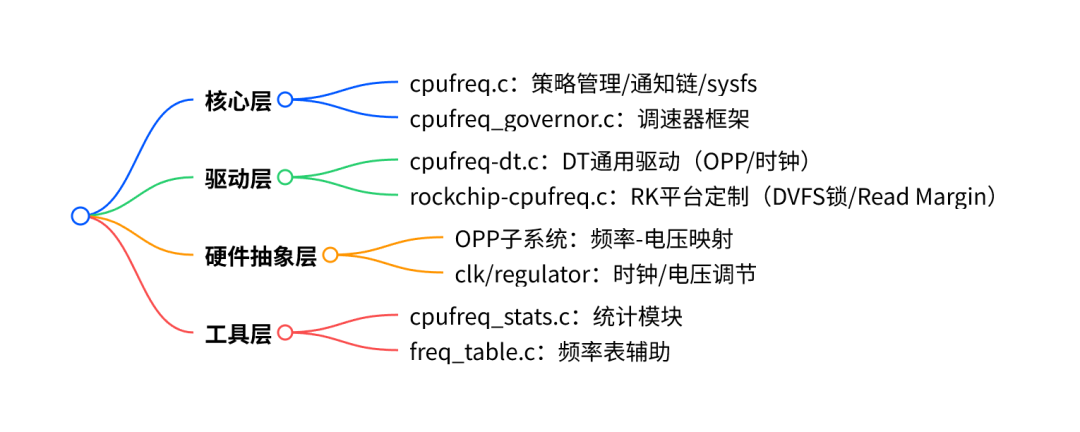
cpufreq驱动的代码分布清晰,核心文件各司其职:
drivers/cpufreq/├── cpufreq.c # 核心框架:策略管理、通知链、sysfs├── cpufreq-dt.c # DT 通用驱动:OPP 解析、时钟操作├── cpufreq-dt.h # DT 驱动接口定义├── rockchip-cpufreq.c # RK 平台驱动:SoC 特性、DVFS 锁、监控├── rockchip-cpufreq.h # RK 驱动导出接口├── cpufreq_governor.c # 调速器公共框架├── cpufreq_governor.h # 调速器数据结构├── cpufreq_interactive.c # Interactive 调速器实现├── cpufreq_ondemand.c # Ondemand 调速器实现├── freq_table.c # 频率表辅助函数└── cpufreq_stats.c # 统计信息模块
2.2 核心结构体关系(代码定义)
cpufreq的核心逻辑围绕两个结构体展开,是理解整个框架的关键:
// include/linux/cpufreq.hstruct cpufreq_policy {cpumask_var_t cpus; // 本策略管理的 CPU 掩码cpumask_var_t related_cpus; // 硬件相关的 CPU(共享时钟)unsigned int min; // 用户设置的最小频率unsigned int max; // 用户设置的最大频率unsigned int cur; // 当前频率(kHz)struct cpufreq_governor *governor; // 当前调速器void *governor_data; // 调速器私有数据struct cpufreq_frequency_table *freq_table; // 频率表struct cpufreq_stats *stats; // 统计信息struct kobject kobj; // sysfs 对象void *driver_data; // 驱动私有数据// ... 更多字段};struct cpufreq_driver {char name[CPUFREQ_NAME_LEN];unsigned int flags;/* 必须实现的回调 */int (*target_index)(struct cpufreq_policy *policy, unsigned int index);unsigned int (*get)(unsigned int cpu);/* 可选回调 */int (*init)(struct cpufreq_policy *policy);int (*exit)(struct cpufreq_policy *policy);int (*online)(struct cpufreq_policy *policy);int (*offline)(struct cpufreq_policy *policy);// ...};
脑图:RK3576 CPUFreq核心架构
三、初始化流程:从模块加载到频率就绪
RK3576的cpufreq初始化是“先集群初始化,再注册驱动”的逻辑,核心分为三步:
3.1 驱动入口:rockchip_cpufreq_driver_init
这是整个RK平台cpufreq的入口函数,核心逻辑是遍历CPU集群、初始化集群信息、注册通知链和平台设备:
// drivers/cpufreq/rockchip-cpufreq.cstatic int __init rockchip_cpufreq_driver_init(void){struct cluster_info *cluster, *pos;struct cpufreq_dt_platform_data pdata = {0};int cpu, ret;bool is_opp_shared_cpu_bus = false;/* 遍历所有可能的 CPU,为每个 cluster 初始化 */for_each_possible_cpu(cpu) {cluster = rockchip_cluster_info_lookup(cpu);if (cluster)continue; // 已初始化过cluster = kzalloc(sizeof(*cluster), GFP_KERNEL);if (!cluster) {ret = -ENOMEM;goto release_cluster_info;}/* 核心初始化:解析 OPP、获取 regulator、设置 SoC 信息 */ret = rockchip_cpufreq_cluster_init(cpu, cluster);if (ret) {pr_err("Failed to initialize dvfs info cpu%dn", cpu);goto release_cluster_info;}list_add(&cluster->list_head, &cluster_info_list);if (cluster->is_opp_shared_cpu_bus)is_opp_shared_cpu_bus = true;}/* 设置平台数据 */pdata.have_governor_per_policy = true;pdata.suspend = rockchip_cpufreq_suspend;/* 注册 cpufreq 通知链 */ret = cpufreq_register_notifier(&rockchip_cpufreq_notifier_block,CPUFREQ_POLICY_NOTIFIER);if (ret) {pr_err("failed to register cpufreq notifiern");goto release_cluster_info;}/* 如果存在 OPP 共享总线,注册 transition 通知器 */if (is_opp_shared_cpu_bus) {ret = cpufreq_register_notifier(&rockchip_cpufreq_transition_notifier_block,CPUFREQ_TRANSITION_NOTIFIER);// ...}/* 注册 panic 通知器,用于调试 */ret = atomic_notifier_chain_register(&panic_notifier_list,&rockchip_cpufreq_panic_notifier_block);/* 注册 platform_device,触发 cpufreq-dt 驱动 probe */return PTR_ERR_OR_ZERO(platform_device_register_data(NULL, "cpufreq-dt",-1, (void *)&pdata, sizeof(struct cpufreq_dt_platform_data)));}module_init(rockchip_cpufreq_driver_init);// drivers/cpufreq/rockchip-cpufreq.cstatic int __init rockchip_cpufreq_driver_init(void){struct cluster_info *cluster, *pos;struct cpufreq_dt_platform_data pdata = {0};int cpu, ret;bool is_opp_shared_cpu_bus = false;/* 遍历所有可能的 CPU,为每个 cluster 初始化 */for_each_possible_cpu(cpu) {cluster = rockchip_cluster_info_lookup(cpu);if (cluster)continue; // 已初始化过cluster = kzalloc(sizeof(*cluster), GFP_KERNEL);if (!cluster) {ret = -ENOMEM;goto release_cluster_info;}/* 核心初始化:解析 OPP、获取 regulator、设置 SoC 信息 */ret = rockchip_cpufreq_cluster_init(cpu, cluster);if (ret) {pr_err("Failed to initialize dvfs info cpu%dn", cpu);goto release_cluster_info;}list_add(&cluster->list_head, &cluster_info_list);if (cluster->is_opp_shared_cpu_bus)is_opp_shared_cpu_bus = true;}/* 设置平台数据 */pdata.have_governor_per_policy = true;pdata.suspend = rockchip_cpufreq_suspend;/* 注册 cpufreq 通知链 */ret = cpufreq_register_notifier(&rockchip_cpufreq_notifier_block,CPUFREQ_POLICY_NOTIFIER);if (ret) {pr_err("failed to register cpufreq notifiern");goto release_cluster_info;}/* 如果存在 OPP 共享总线,注册 transition 通知器 */if (is_opp_shared_cpu_bus) {ret = cpufreq_register_notifier(&rockchip_cpufreq_transition_notifier_block,CPUFREQ_TRANSITION_NOTIFIER);// ...}/* 注册 panic 通知器,用于调试 */ret = atomic_notifier_chain_register(&panic_notifier_list,&rockchip_cpufreq_panic_notifier_block);/* 注册 platform_device,触发 cpufreq-dt 驱动 probe */return PTR_ERR_OR_ZERO(platform_device_register_data(NULL, "cpufreq-dt",-1, (void *)&pdata, sizeof(struct cpufreq_dt_platform_data)));}module_init(rockchip_cpufreq_driver_init);
3.2 Cluster初始化:rockchip_cpufreq_cluster_init
每个CPU集群(大核/小核)的初始化核心是解析OPP表、获取电压调节器、读取SoC特有信息:
Cstatic int rockchip_cpufreq_cluster_init(int cpu, struct cluster_info *cluster){ struct rockchip_opp_info *opp_info = &cluster->opp_info; struct device_node *np; struct device *dev; char *reg_name; int ret = 0; u32 freq = 0; dev = get_cpu_device(cpu); if (!dev) return -ENODEV; /* 从 CPU 节点获取 operating-points-v2 phandle */ np = of_parse_phandle(dev->of_node, "operating-points-v2", 0); if (!np) { dev_warn(dev, "OPP-v2 not supportedn"); return -ENOENT; } /* 获取共享 OPP 的 CPU 掩码(大核/小核 cluster) */ ret = dev_pm_opp_of_get_sharing_cpus(dev, &cluster->cpus); if (ret) { dev_err(dev, "Failed to get sharing cpusn"); of_node_put(np); return ret; } /* 检查是否共享 DSU/CCI 总线 OPP */ if (of_property_read_bool(np, "rockchip,opp-shared-dsu") || of_property_read_bool(np, "rockchip,opp-shared-cci")) cluster->is_opp_shared_cpu_bus = true; /* 读取 CPU 到总线频率的百分比 */ of_property_read_u32(np, "rockchip,cpu-freq-percent", &cluster->cpu_freq_percent); /* 读取空闲阈值频率 */ if (!of_property_read_u32(np, "rockchip,idle-threshold-freq", &freq)) cluster->idle_threshold_freq = freq; of_node_put(np); /* 确定 regulator 名称 */ if (of_find_property(dev->of_node, "cpu-supply", NULL)) reg_name = "cpu"; else if (of_find_property(dev->of_node, "cpu0-supply", NULL)) reg_name = "cpu0"; else return -ENOENT; /* 获取 SoC 特定的 OPP 数据处理函数 */ rockchip_get_opp_data(rockchip_cpufreq_of_match, opp_info); /* 初始化 OPP 信息:读取 nvmem、设置 supported_hw */ ret = rockchip_init_opp_info(dev, opp_info, NULL, reg_name); if (ret) dev_err(dev, "failed to init opp infon"); return ret;}
3.3 RK3576特有的SoC信息读取
RK3576不同版本(M/J/S)的频率/电压支持不同,核心是从nvmem读取芯片规格:
static int rk3576_cpu_get_soc_info(struct device *dev, struct device_node *np,int *bin, int *process){int ret = 0;u8 spec = 0, test_version = 0;if (!bin)return 0;/* 从 nvmem 读取芯片规格序列号 */if (of_property_match_string(np, "nvmem-cell-names","specification_serial_number") >= 0) {ret = rockchip_nvmem_cell_read_u8(np,"specification_serial_number",&spec);if (ret) {dev_err(dev, "Failed to get specification_serial_numbern");return ret;}}/* 读取测试版本 */if (of_property_match_string(np, "nvmem-cell-names", "test_version") >= 0) {ret = rockchip_nvmem_cell_read_u8(np, "test_version", &test_version);if (ret) {dev_err(dev, "Failed to get test_versionn");return ret;}}/* 根据 spec 值判断芯片型号 */if (spec == 0xd) {*bin = 1; /* RK3576M */} else if (spec == 0xa) {*bin = 2; /* RK3576J */} else if (spec == 0x13) {if (test_version == 0) {*bin = 3; /* RK3576S */} else {*bin = 0;dev_info(dev, "bin=%d (3)n", *bin);return 0;}}if (*bin < 0)*bin = 0;dev_info(dev, "bin=%dn", *bin);return ret;}
流程图:RK3576 CPUFreq初始化流程
st=>start: 模块加载(rockchip_cpufreq_driver_init)op1=>operation: 遍历所有CPUop2=>operation: 查找/创建cluster_infoop3=>operation: rockchip_cpufreq_cluster_initop4=>operation: 解析OPP-v2节点op5=>operation: 获取共享CPU掩码/总线信息op6=>operation: 读取SoC信息(nvmem)op7=>operation: 注册策略/转换通知链op8=>operation: 注册cpufreq-dt平台设备e=>end: 触发cpufreq-dt probe,初始化完成st->op1->op2->op3->op4->op5->op6->op7->op8->e
四、频率调整核心:从Governor到硬件
频率调整是cpufreq的核心流程,完整链路是:调速器决策→ 核心层处理 → 驱动层执行 → OPP子系统 → 硬件(时钟/电压)
4.1 调速器决策:interactive为例
interactive是嵌入式场景最常用的调速器,核心是“按需快速升频,缓慢降频”,关键逻辑在负载计算和频率评估:
// drivers/cpufreq/cpufreq_interactive.c/* 核心数据结构 */struct interactive_cpu {struct update_util_data update_util; // 注册到调度器的钩子struct interactive_policy *ipolicy;struct irq_work irq_work; // 中断上下文工作u64 last_sample_time;bool work_in_progress;/* 负载计算相关 */spinlock_t load_lock;u64 time_in_idle;u64 time_in_idle_timestamp;u64 cputime_speedadj; // 加权 CPU 时间/* 频率控制 */spinlock_t target_freq_lock;unsigned int target_freq;unsigned int floor_freq; // 最低允许频率u64 pol_floor_val_time; // 策略级 floor 时间u64 loc_floor_val_time; // CPU 级 floor 时间// ...};/* 调度器回调:每次 CPU 状态更新时调用 */static void dbs_update_util_handler(struct update_util_data *data, u64 time,unsigned int flags){struct interactive_cpu *icpu = container_of(data, struct interactive_cpu, update_util);struct interactive_policy *ipolicy = icpu->ipolicy;struct interactive_tunables *tunables = ipolicy->tunables;u64 delta_ns, lst;/* 检查是否可以更新 */if (!cpufreq_this_cpu_can_update(ipolicy->policy))return;/* 避免重复工作 */if (icpu->work_in_progress)return;/* 检查采样间隔 */lst = READ_ONCE(icpu->last_sample_time);delta_ns = time - lst;if ((s64)delta_ns < tunables->sampling_rate * NSEC_PER_USEC)return;/* 提交 irq_work,在中断上下文执行 */icpu->last_sample_time = time;icpu->work_in_progress = true;irq_work_queue(&icpu->irq_work);}/* 实际频率评估函数 */static void eval_target_freq(struct interactive_cpu *icpu){struct interactive_tunables *tunables = icpu->ipolicy->tunables;struct cpufreq_policy *policy = icpu->ipolicy->policy;u64 cputime_speedadj, now, max_fvtime;unsigned int new_freq, loadadjfreq, delta_time;unsigned long flags;int cpu_load;/* 计算 CPU 负载 */spin_lock_irqsave(&icpu->load_lock, flags);now = update_load(icpu, smp_processor_id());delta_time = (unsigned int)(now - icpu->cputime_speedadj_timestamp);cputime_speedadj = icpu->cputime_speedadj;spin_unlock_irqrestore(&icpu->load_lock, flags);if (!delta_time)return;/* 计算负载百分比 */cpu_load = (unsigned int)(100 * cputime_speedadj / delta_time) / policy->cur;spin_lock_irqsave(&icpu->target_freq_lock, flags);/* 根据负载选择目标频率 */loadadjfreq = cpu_load * policy->cur;if (cpu_load >= tunables->go_hispeed_load) {/* 高负载:进入 hispeed_freq */if (policy->cur < tunables->hispeed_freq) {new_freq = tunables->hispeed_freq;} else {new_freq = choose_freq(icpu, loadadjfreq);/* 检查 above_hispeed_delay */if (now - max_fvtime < freq_to_above_hispeed_delay(tunables, new_freq))new_freq = max(new_freq, tunables->hispeed_freq);}} else {/* 低负载:按比例降频 */new_freq = choose_freq(icpu, loadadjfreq);}/* 应用 floor 约束 */if (new_freq < icpu->floor_freq) {if (now - icpu->pol_floor_val_time < tunables->min_sample_time)new_freq = icpu->floor_freq;}/* 限制在策略范围内 */new_freq = max(new_freq, policy->min);new_freq = min(new_freq, policy->max);/* 提交频率变更 */if (new_freq != policy->cur) {icpu->target_freq = new_freq;spin_lock(&speedchange_cpumask_lock);cpumask_set_cpu(smp_processor_id(), &speedchange_cpumask);spin_unlock(&speedchange_cpumask_lock);wake_up_process(speedchange_task); // 唤醒内核线程执行变更}spin_unlock_irqrestore(&icpu->target_freq_lock, flags);}
4.2 频率选择算法:choose_freq
interactive调速器的核心算法,用二分查找思想找到满足负载的最低频率:
/** 选择满足目标负载的最低频率* 采用二分查找思想,在频率表中寻找最优解*/static unsigned int choose_freq(struct interactive_cpu *icpu,unsigned int loadadjfreq){struct cpufreq_policy *policy = icpu->ipolicy->policy;struct cpufreq_frequency_table *freq_table = policy->freq_table;unsigned int prevfreq, freqmin = 0, freqmax = UINT_MAX, tl;unsigned int freq = policy->cur;int index;do {prevfreq = freq;/* 获取当前频率的目标负载 */tl = freq_to_targetload(icpu->ipolicy->tunables, freq);/** 查找满足 loadadjfreq / tl <= freq 的最低频率* 即:freq >= loadadjfreq / tl*/index = cpufreq_frequency_table_target(policy, loadadjfreq / tl,CPUFREQ_RELATION_L);freq = freq_table[index].frequency;if (freq > prevfreq) {/* 频率上升:记录最小值 */freqmin = prevfreq;if (freq >= freqmax) {/* 超过上限,回退 */index = cpufreq_frequency_table_target(policy, freqmax - 1,CPUFREQ_RELATION_H);freq = freq_table[index].frequency;if (freq == freqmin)break;}} else if (freq < prevfreq) {/* 频率下降:记录最大值 */freqmax = prevfreq;if (freq <= freqmin) {/* 低于下限,回退 */index = cpufreq_frequency_table_target(policy, freqmin + 1,CPUFREQ_RELATION_L);freq = freq_table[index].frequency;if (freq == freqmax)break;}}} while (freq != prevfreq);return freq;}
4.3 核心层频率切换:cpufreq_core
核心层负责频率切换的同步、通知和状态管理,保证线程安全:
// drivers/cpufreq/cpufreq.c/* 开始频率转换 */void cpufreq_freq_transition_begin(struct cpufreq_policy *policy,struct cpufreq_freqs *freqs){/* 防止重复调用导致死锁 */WARN_ON(!(cpufreq_driver->flags & CPUFREQ_ASYNC_NOTIFICATION)&& current == policy->transition_task);wait:/* 等待前一次转换完成 */wait_event(policy->transition_wait, !policy->transition_ongoing);spin_lock(&policy->transition_lock);if (unlikely(policy->transition_ongoing)) {spin_unlock(&policy->transition_lock);goto wait;}policy->transition_ongoing = true;policy->transition_task = current;spin_unlock(&policy->transition_lock);/* 发送 PRECHANGE 通知 */cpufreq_notify_transition(policy, freqs, CPUFREQ_PRECHANGE);}/* 频率转换通知 */static void cpufreq_notify_transition(struct cpufreq_policy *policy,struct cpufreq_freqs *freqs,unsigned int state){int cpu;freqs->policy = policy;freqs->flags = cpufreq_driver->flags;switch (state) {case CPUFREQ_PRECHANGE:/* 同步 old frequency */if (policy->cur && policy->cur != freqs->old) {freqs->old = policy->cur;}/* 调用 transition notifier 链 */srcu_notifier_call_chain(&cpufreq_transition_notifier_list,CPUFREQ_PRECHANGE, freqs);/* 调整 loops_per_jiffy */adjust_jiffies(CPUFREQ_PRECHANGE, freqs);break;case CPUFREQ_POSTCHANGE:adjust_jiffies(CPUFREQ_POSTCHANGE, freqs);/* 记录 tracepoint */for_each_cpu(cpu, policy->cpus)trace_cpu_frequency(freqs->new, cpu);/* 调用 transition notifier 链 */srcu_notifier_call_chain(&cpufreq_transition_notifier_list,CPUFREQ_POSTCHANGE, freqs);/* 更新统计 */cpufreq_stats_record_transition(policy, freqs->new);policy->cur = freqs->new;}}/* 结束频率转换 */void cpufreq_freq_transition_end(struct cpufreq_policy *policy,struct cpufreq_freqs *freqs,int transition_failed){cpufreq_notify_post_transition(policy, freqs, transition_failed);/* 更新频率缩放比例(用于调度器) */arch_set_freq_scale(policy->related_cpus,policy->cur,policy->cpuinfo.max_freq);spin_lock(&policy->transition_lock);policy->transition_ongoing = false;policy->transition_task = NULL;spin_unlock(&policy->transition_lock);wake_up(&policy->transition_wait);}
4.4 驱动层实现:cpufreq-dt
DT驱动是通用层,对接核心层和平台层,核心是频率/电压的实际设置:
// drivers/cpufreq/cpufreq-dt.c/* 设置目标频率 */static int set_target(struct cpufreq_policy *policy, unsigned int index){struct private_data *priv = policy->driver_data;unsigned long freq = policy->freq_table[index].frequency;/* RK 平台使用特殊的 OPP 设置函数 */return rockchip_cpufreq_opp_set_rate(priv->cpu_dev, freq * 1000);return dev_pm_opp_set_rate(priv->cpu_dev, freq * 1000);}/* 驱动初始化 */static int cpufreq_init(struct cpufreq_policy *policy){struct private_data *priv;struct device *cpu_dev;struct clk *cpu_clk;unsigned int transition_latency;int ret;priv = cpufreq_dt_find_data(policy->cpu);if (!priv) {pr_err("failed to find data for cpu%dn", policy->cpu);return -ENODEV;}cpu_dev = priv->cpu_dev;/* 获取 CPU 时钟 */cpu_clk = clk_get(cpu_dev, NULL);if (IS_ERR(cpu_clk)) {ret = PTR_ERR(cpu_clk);dev_err(cpu_dev, "%s: failed to get clk: %dn", __func__, ret);return ret;}/* 获取最大转换延迟 */transition_latency = dev_pm_opp_get_max_transition_latency(cpu_dev);if (!transition_latency)transition_latency = CPUFREQ_ETERNAL;/* 填充 policy */cpumask_copy(policy->cpus, priv->cpus);policy->driver_data = priv;policy->clk = cpu_clk;policy->freq_table = priv->freq_table;policy->suspend_freq = dev_pm_opp_get_suspend_opp_freq(cpu_dev) / 1000;policy->cpuinfo.transition_latency = transition_latency;policy->dvfs_possible_from_any_cpu = true;/* 支持 boost 模式 */if (policy_has_boost_freq(policy)) {ret = cpufreq_enable_boost_support();if (ret)goto out_clk_put;cpufreq_dt_attr[1] = &cpufreq_freq_attr_scaling_boost_freqs;}return 0;out_clk_put:clk_put(cpu_clk);return ret;}static struct cpufreq_driver dt_cpufreq_driver = {.flags = CPUFREQ_NEED_INITIAL_FREQ_CHECK |CPUFREQ_IS_COOLING_DEV,.verify = cpufreq_generic_frequency_table_verify,.target_index = set_target,.get = cpufreq_generic_get,.init = cpufreq_init,.exit = cpufreq_exit,.online = cpufreq_online,.offline = cpufreq_offline,.register_em = cpufreq_register_em_with_opp,.name = "cpufreq-dt",.attr = cpufreq_dt_attr,.suspend = cpufreq_generic_suspend,};
4.5 RK平台特殊处理:rockchip_cpufreq
RK3576的定制化逻辑,包括DVFS锁、Read Margin、多路电压调节器:
// drivers/cpufreq/rockchip-cpufreq.c/* RK 平台频率设置入口 */int rockchip_cpufreq_opp_set_rate(struct device *dev, unsigned long target_freq){struct cluster_info *cluster;struct dev_pm_opp *opp;struct rockchip_opp_info *opp_info;struct dev_pm_opp_supply supplies[2] = {0};unsigned long freq;int ret = 0;cluster = rockchip_cluster_info_lookup(dev->id);if (!cluster)return -EINVAL;opp_info = &cluster->opp_info;/* 获取 DVFS 锁,防止并发修改 */rockchip_opp_dvfs_lock(opp_info);/* 调用 OPP 子系统设置频率 */ret = dev_pm_opp_set_rate(dev, target_freq);if (!ret) {cluster->rate = freq = target_freq;/* 查找当前 OPP,获取电压信息 */opp = dev_pm_opp_find_freq_ceil(dev, &freq);if (!IS_ERR(opp)) {dev_pm_opp_get_supplies(opp, supplies);cluster->volt = supplies[0].u_volt;if (opp_info->regulator_count > 1)cluster->mem_volt = supplies[1].u_volt;dev_pm_opp_put(opp);}}rockchip_opp_dvfs_unlock(opp_info);return ret;}EXPORT_SYMBOL_GPL(rockchip_cpufreq_opp_set_rate);/* RK3576 Read Margin 设置 */static int rk3576_cpu_set_read_margin(struct device *dev,struct rockchip_opp_info *opp_info,u32 rm){if (!opp_info->volt_rm_tbl)return 0;if (rm == opp_info->current_rm || rm == UINT_MAX)return 0;dev_dbg(dev, "set rm to %dn", rm);/* 通过 GRF 配置 Read Margin */if (opp_info->grf) {/* CPU0-3 核心 */regmap_write(opp_info->grf, 0x3c, 0x001c0000 | (rm << 2));regmap_write(opp_info->grf, 0x44, 0x001c0000 | (rm << 2));/* 触发更新 */regmap_write(opp_info->grf, 0x38, 0x00020002);udelay(1);regmap_write(opp_info->grf, 0x38, 0x00020000);}/* CCI 接口 */if (opp_info->cci_grf)regmap_write(opp_info->cci_grf, 0x54, 0x001c0000 | (rm << 2));opp_info->current_rm = rm;return 0;}/* 多路 regulator 配置 */static int cpu_opp_config_regulators(struct device *dev,struct dev_pm_opp *old_opp,struct dev_pm_opp *new_opp,struct regulator **regulators,unsigned int count){struct cluster_info *cluster;cluster = rockchip_cluster_info_lookup(dev->id);if (!cluster)return -EINVAL;return rockchip_opp_config_regulators(dev, old_opp, new_opp, regulators,count, &cluster->opp_info);}
流程图:RK3576频率调整完整流程
st=>start: 调度器触发负载更新op1=>operation: interactive调速器(eval_target_freq)op2=>operation: 计算CPU负载,选择目标频率op3=>operation: 核心层(cpufreq_freq_transition_begin)op4=>operation: 发送PRECHANGE通知op5=>operation: 驱动层(set_target)op6=>operation: RK平台(rockchip_cpufreq_opp_set_rate)op7=>operation: OPP子系统(dev_pm_opp_set_rate)op8=>operation: 升频:先升压后升频;降频:先降频后降压op9=>operation: 核心层(cpufreq_freq_transition_end)op10=>operation: 发送POSTCHANGE通知,更新统计e=>end: 频率切换完成st->op1->op2->op3->op4->op5->op6->op7->op8->op9->op10->e
五、OPP子系统:频率-电压表的奥秘
OPP(Operating Performance Point)是连接软件和硬件的关键,定义了“频率-电压”的映射关系,是DVFS的基础。
5.1 OPP数据结构
// include/linux/pm_opp.hstruct dev_pm_opp {struct list_head node;unsigned long rate; // 频率 (Hz)unsigned long u_volt; // 电压 (uV)unsigned long u_volt_min; // 最小电压unsigned long u_volt_max; // 最大电压struct device_opp *dev_opp; // 所属设备/* 支持的条件 */unsigned long supported_hw; // 硬件版本掩码/* 供电信息 */struct opp_supply *supplies;unsigned int supply_count;/* 自定义数据 */void *priv;};struct device_opp {struct list_head node;struct device *dev;struct srcu_notifier_head srcu_head;struct list_head opp_list;struct clk *clk;struct regulator **regulators;unsigned int regulator_count;struct opp_table *opp_table;};
5.2 Device Tree OPP定义
RK3576的OPP表在DTS中定义,不同芯片版本支持不同频率:
// arch/arm64/boot/dts/rockchip/rk3576.dtsicpu0_opp_table: opp-table-0 {compatible = "operating-points-v2";opp-shared;/* 408 MHz */opp-408000000 {opp-hz = /bits/ 64 <408000000>;opp-microvolt = <800000>;clock-latency-ns = <40000>;};/* 600 MHz */opp-600000000 {opp-hz = /bits/ 64 <600000000>;opp-microvolt = <825000>;};/* 816 MHz */opp-816000000 {opp-hz = /bits/ 64 <816000000>;opp-microvolt = <850000>;};/* 1.2 GHz */opp-1200000000 {opp-hz = /bits/ 64 <1200000000>;opp-microvolt = <925000>;};/* 1.608 GHz - 仅支持特定芯片版本 */opp-1608000000 {opp-hz = /bits/ 64 <1608000000>;opp-microvolt = <1100000>;opp-supported-hw = <0x1 0x1>; // bin=0, volt_sel=0};/* 1.8 GHz - 更高规格芯片 */opp-1800000000 {opp-hz = /bits/ 64 <1800000000>;opp-microvolt = <1175000>;opp-supported-hw = <0x1 0x3>; // bin=0, volt_sel=0,1,2};};
5.3 OPP查找与设置流程
OPP子系统的核心函数,负责频率/电压的实际设置:
// drivers/opp/core.c/*** dev_pm_opp_set_rate() - 设置设备到指定频率* @dev: 设备* @target_freq: 目标频率 (Hz)** 1. 查找匹配的 OPP* 2. 设置 regulator 电压* 3. 设置时钟频率*/int dev_pm_opp_set_rate(struct device *dev, unsigned long target_freq){struct device_opp *dev_opp;struct dev_pm_opp *opp;struct clk *clk;unsigned long old_freq, new_freq;int ret;dev_opp = _find_device_opp(dev);if (IS_ERR(dev_opp))return PTR_ERR(dev_opp);clk = dev_opp->clk;old_freq = clk_get_rate(clk);/* 查找目标频率对应的 OPP */opp = _find_freq_ceil(dev_opp, &target_freq);if (IS_ERR(opp)) {ret = PTR_ERR(opp);goto put_opp;}new_freq = opp->rate;/* 如果频率相同,只更新电压 */if (new_freq == old_freq) {ret = _set_opp_voltage(dev, dev_opp, opp);goto put_opp;}/* 升频:先升压,后升频 */if (new_freq > old_freq) {ret = _set_opp_voltage(dev, dev_opp, opp);if (ret)goto put_opp;ret = clk_set_rate(clk, new_freq);if (ret) {/* 回滚电压 */_set_opp_voltage(dev, dev_opp, _find_freq_floor(dev_opp, &old_freq));}} else {/* 降频:先降频,后降压 */ret = clk_set_rate(clk, new_freq);if (ret)goto put_opp;_set_opp_voltage(dev, dev_opp, opp);}put_opp:dev_pm_opp_put(opp);return ret;}
流程图:OPP频率-电压设置流程
st=>start: 调用dev_pm_opp_set_rateop1=>operation: 查找设备对应的device_oppop2=>operation: 获取当前时钟频率(old_freq)op3=>operation: 查找目标频率的OPP(ceil)op4=>operation: 判断new_freq == old_freq?op5=>operation: 仅更新电压(_set_opp_voltage)op6=>operation: new_freq > old_freq?op7=>operation: 先升压,后升频op8=>operation: 升频失败,回滚电压op9=>operation: 先降频,后降压e=>end: 返回设置结果st->op1->op2->op3->op4op4(yes)->op5->eop4(no)->op6op6(yes)->op7->eop7(no)->op8->eop6(no)->op9->e
六、通知链机制:频率变更的广播系统
cpufreq的通知链是“事件广播”机制,允许其他子系统(如温控、功耗管理)监听频率变更事件,是内核模块化设计的典型体现。
6.1 两种通知链
// drivers/cpufreq/cpufreq.c/* 策略通知链:策略创建/销毁时调用 */static BLOCKING_NOTIFIER_HEAD(cpufreq_policy_notifier_list);/* 转换通知链:频率变更前后调用 */SRCU_NOTIFIER_HEAD_STATIC(cpufreq_transition_notifier_list);
6.2 RK平台的通知器注册
RK3576通过通知链实现“频率-空闲状态”联动、总线QoS约束:
// drivers/cpufreq/rockchip-cpufreq.c/* 策略通知器:处理监控注册和总线 QoS */static int rockchip_cpufreq_notifier(struct notifier_block *nb,unsigned long event, void *data){struct cpufreq_policy *policy = data;struct cluster_info *cluster;cluster = rockchip_cluster_info_lookup(policy->cpu);if (!cluster)return NOTIFY_BAD;switch (event) {case CPUFREQ_CREATE_POLICY:/* 注册系统监控 */if (rockchip_cpufreq_add_monitor(cluster, policy))return NOTIFY_BAD;/* 添加总线频率 QoS 约束 */if (rockchip_cpufreq_add_bus_qos_req(cluster, policy))return NOTIFY_BAD;break;case CPUFREQ_REMOVE_POLICY:rockchip_cpufreq_remove_monitor(cluster);rockchip_cpufreq_remove_bus_qos(cluster);break;}return NOTIFY_OK;}/* 转换通知器:处理空闲状态 */static int rockchip_cpufreq_transition_notifier(struct notifier_block *nb,unsigned long event, void *data){struct cpufreq_freqs *freqs = data;struct cpufreq_policy *policy = freqs->policy;struct cluster_info *cluster;cluster = rockchip_cluster_info_lookup(policy->cpu);if (!cluster)return NOTIFY_BAD;switch (event) {case CPUFREQ_PRECHANGE:/* 高频时禁用深层空闲状态 */if (cluster->idle_threshold_freq &&freqs->new >= cluster->idle_threshold_freq &&!cluster->is_idle_disabled) {rockchip_cpufreq_idle_state_disable(policy->cpus, 1, true);cluster->is_idle_disabled = true;}break;case CPUFREQ_POSTCHANGE:/* 低频时重新启用空闲状态 */if (cluster->idle_threshold_freq &&freqs->new < cluster->idle_threshold_freq &&cluster->is_idle_disabled) {rockchip_cpufreq_idle_state_disable(policy->cpus, 1, false);cluster->is_idle_disabled = false;}/* 更新总线频率请求 */rockchip_cpufreq_update_bus_req(cluster, freqs->new);break;}return NOTIFY_OK;}
6.3 使用场景示例
温控驱动通过通知链监听频率变更,更新热模型:
/* 温度管理驱动注册通知器 */static int thermal_cpufreq_notifier(struct notifier_block *nb,unsigned long event, void *data){struct cpufreq_freqs *freqs = data;if (event == CPUFREQ_POSTCHANGE) {/* 频率变更后更新热模型 */update_thermal_model(freqs->new);}return NOTIFY_OK;}static struct notifier_block thermal_nb = {.notifier_call = thermal_cpufreq_notifier,};/* 注册 */cpufreq_register_notifier(&thermal_nb, CPUFREQ_TRANSITION_NOTIFIER);
七、统计与调试:洞察系统行为
掌握调试技巧,才能快速定位频率调节的问题,cpufreq提供了丰富的统计和调试接口。
7.1 统计模块实现
// drivers/cpufreq/cpufreq_stats.cstruct cpufreq_stats {unsigned int total_trans; // 总切换次数unsigned long long last_time; // 上次更新时间unsigned int max_state; // 最大状态数unsigned int state_num; // 实际状态数unsigned int last_index; // 当前状态索引u64 *time_in_state; // 各频率驻留时间unsigned int *freq_table; // 频率表unsigned int *trans_table; // 切换矩阵};/* 记录一次频率切换 */void cpufreq_stats_record_transition(struct cpufreq_policy *policy,unsigned int new_freq){struct cpufreq_stats *stats = policy->stats;int old_index, new_index;if (!stats)return;old_index = stats->last_index;new_index = freq_table_get_index(stats, new_freq);if (old_index == -1 || new_index == -1 || old_index == new_index)return;/* 更新驻留时间 */cpufreq_stats_update(stats, stats->last_time);stats->last_index = new_index;stats->trans_table[old_index * stats->max_state + new_index]++;stats->total_trans++;}
7.2 调试技巧
# 1. 查看当前频率和策略cat /sys/devices/system/cpu/cpu0/cpufreq/scaling_cur_freqcat /sys/devices/system/cpu/cpu0/cpufreq/scaling_governorcat /sys/devices/system/cpu/cpu0/cpufreq/scaling_min_freqcat /sys/devices/system/cpu/cpu0/cpufreq/scaling_max_freq# 2. 查看频率驻留时间统计cat /sys/devices/system/cpu/cpu0/cpufreq/stats/time_in_state# 输出格式: 频率(Hz) 时间(时钟周期)# 408000 1234567# 600000 2345678# ...# 3. 查看频率切换矩阵cat /sys/devices/system/cpu/cpu0/cpufreq/stats/trans_table# 显示从每个频率切换到其他频率的次数# 4. 查看可用频率和调速器cat /sys/devices/system/cpu/cpu0/cpufreq/scaling_available_frequenciescat /sys/devices/system/cpu/cpu0/cpufreq/scaling_available_governors# 5. 动态切换调速器echo userspace > /sys/devices/system/cpu/cpu0/cpufreq/scaling_governorecho 1200000 > /sys/devices/system/cpu/cpu0/cpufreq/scaling_setspeed# 6. 内核日志调试dmesg | grep -i cpufreqdmesg | grep -i "rk3576|rockchip"# 7. 使用 tracepointcd /sys/kernel/debug/tracingecho 1 > events/cpufreq/enablecat trace
八、实战:自定义调速器开发
掌握自定义调速器的开发,才能适配特定场景的性能/功耗需求。
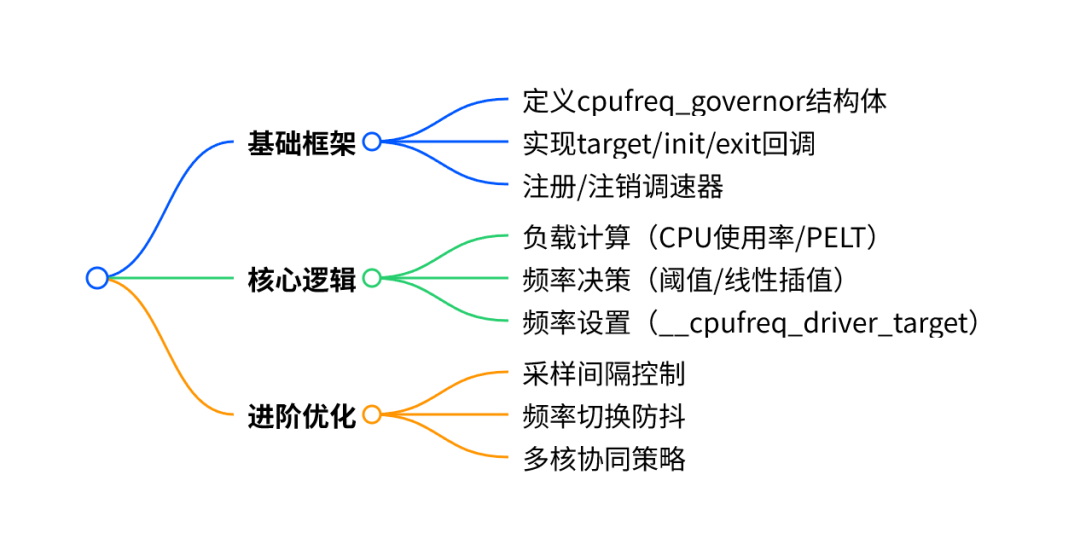
8.1 最小调速器框架
static int mygov_target(struct cpufreq_policy *policy, unsigned int target_freq,unsigned int relation){/* 简单的频率设置 */return __cpufreq_driver_target(policy, target_freq, relation);}static int mygov_init(struct cpufreq_policy *policy){/* 初始化 */return 0;}static void mygov_exit(struct cpufreq_policy *policy){/* 清理 */}static struct cpufreq_governor my_governor = {.name = "mygov",.target = mygov_target,.init = mygov_init,.exit = mygov_exit,.owner = THIS_MODULE,};static int __init mygov_init_module(void){return cpufreq_register_governor(&my_governor);}static void __exit mygov_exit_module(void){cpufreq_unregister_governor(&my_governor);}module_init(mygov_init_module);module_exit(mygov_exit_module);MODULE_LICENSE("GPL");
8.2 基于负载的调速器
static void mygov_update(struct cpufreq_policy *policy){unsigned int load = calculate_cpu_load(policy);unsigned int new_freq;if (load > 80) {/* 高负载:升频到最大 */new_freq = policy->max;} else if (load < 20) {/* 低负载:降频到最小 */new_freq = policy->min;} else {/* 中等负载:线性插值 */new_freq = policy->min + load * (policy->max - policy->min) / 100;}__cpufreq_driver_target(policy, new_freq, CPUFREQ_RELATION_H);}
脑图:自定义调速器开发
九、性能优化实战
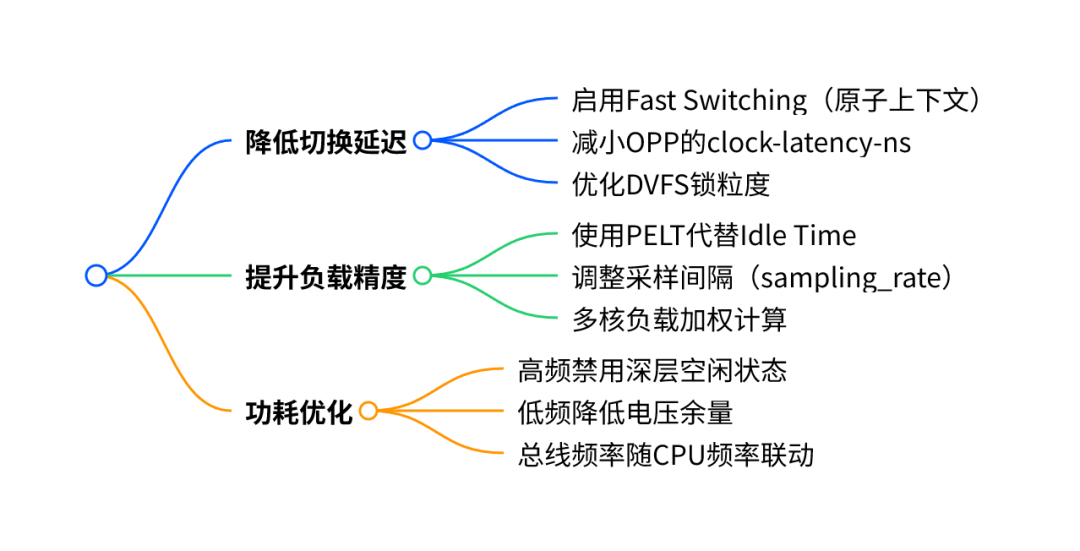
针对实际开发中的痛点,优化频率切换延迟、负载计算精度。
9.1 减少频率切换延迟
/* 1. 使用 fast frequency switching */static struct cpufreq_driver my_driver = {.flags = CPUFREQ_FAST_SWITCHING,.fast_switch = my_fast_switch, // 原子上下文切换};/* 2. 减少 transition latency */// 在 OPP 表中设置较小的 clock-latency-nsopp-1200000000 {opp-hz = /bits/ 64 <1200000000>;clock-latency-ns = <10000>; // 10us,而不是 40us};
9.2 优化负载计算
/* 使用 PELT 信号代替 idle time */static unsigned int get_pelt_load(struct cpufreq_policy *policy){unsigned int cpu = policy->cpu;struct rq *rq = cpu_rq(cpu);/* PELT (Per-Entity Load Tracking) 是调度器内部的负载跟踪机制 */return rq->cfs.avg.util_avg; // 0 ~ 1024}
脑图:性能优化实战
十、总结与延伸
10.1 核心要点回顾
1.分层架构: governor → core → driver → OPP → clk/regulator
2.线程安全: transition_lock、DVFS lock、notifier chain
3.硬件抽象: OPP 表统一频率-电压关系
4.平台特性: RK3576 的 Read Margin、多路 regulator
10.2 延伸阅读
•Documentation/cpu-freq/ - 内核文档
•drivers/opp/ - OPP 子系统实现
•drivers/cpufreq/cpufreq_schedutil.c - 最新 schedutil 调速器
•include/linux/cpufreq.h - 完整 API 定义
10.3 调试 checklist
□dmesg | grep cpufreq 查看初始化日志
□cat scaling_available_frequencies 确认频率表
□cat time_in_state 确认频率切换正常
□trace-cmd record -e cpufreq 抓取切换事件
□检查 regulator 是否支持动态电压调节
写在最后
cpufreq是Linux内核中最接近硬件的子系统之一,理解它不仅能帮你优化系统性能,更能深入理解内核的设备模型、电源管理和并发控制机制。
-
基于RK3576开发板的PWN使用说明2025-05-07 2727
-
【米尔RK3576开发板评测】+项目名称【米尔RK3576开发板评测】一个视频和你共同认识一下米尔RK3576开发板2024-12-18 1748
-
米尔RK3576和RK3588怎么选?-看这篇就够了2024-12-27 2074
-
从性能到成本,深度剖析 RK3588 与 RK3576 怎么选2025-02-09 2041
-
RK3576 vs RK3588:为何越来越多的开发者转向RK3576?2025-05-30 12887
-
Mpp支持RK3576么2025-06-13 6189
-
【作品合集】米尔RK3576开发板测评2025-09-11 60339
-
新品体验 | RK3576开发板2024-11-01 3641
-
RK3576单板发布倒计时:RK3399与RK3576对比2024-12-03 2978
-
RK3588与RK3576区别解析2024-12-17 4860
-
想学人工智能AI?我建议RK3576!2025-02-25 2163
-
瑞芯微RK3576与RK3576S有什么区别,性能参数配置与型号差异解析2025-08-14 3004
-
迅为如何在RK3576上部署YOLOv5;基于RK3576构建智能门禁系统2025-11-25 2209
-
硬核进阶:RK3576 Android15 驱动与系统开发实战指南2026-01-26 977
-
RK3576为何成为中端AIoT设备的黄金选择?深度解析AIoT-3576SE核心优势2026-06-03 613
全部0条评论

快来发表一下你的评论吧 !
