资料下载


USB 3.1/USB Type-C

分享资料个
USB 3.1/USB Type-C
通用串行总线(USB)是20世纪90年代中期发展起来的一种标准,用来规范计算机和外设之间的连接,包括通信和供电。它取代了各种早期的接口,如串行/并行端口,PS / 2,和单独的便携式设备电源充电器。
有三个连接器尺寸-标准,迷你,和微型,类型“A”,“B”和“AB”连接器和相应的容器,和五个数据传输模式总结表1:
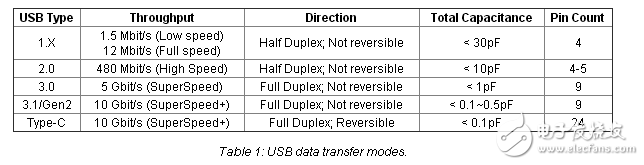
USB 3.1/Gen 2 is essentially USB 3.0 with double the speed, to 10 Gbit/s. It is full duplex and not reversible, so the connector and receptacle has to be aligned in the correct orientation to be inserted. It has a total capacitance of 0.1 ~ 0.5 pF.
USB Type-C is 10 Gbit/s and reversible (similar to Apple’s Lightning) with symmetrical 24 pins so the connector will attach to the receptacle on the first try. The additional pins permit support of data protocols such as DisplayPort 1.3, PCI Express, and Base-t Ethernet using Type C cables. Figure 1 shows the pinout diagram of USB Type-C cable.
声明:本文内容及配图由入驻作者撰写或者入驻合作网站授权转载。文章观点仅代表作者本人,不代表电子发烧友网立场。文章及其配图仅供工程师学习之用,如有内容侵权或者其他违规问题,请联系本站处理。 举报投诉
- 相关下载
- 相关文章