资料下载


dssha1综合SHA-1协处理器

分享资料个
Description
The DSSHA1 is a synthesizable, memory-mapped SHA-1 coprocessor that includes a 64-byte general-purpose RAM that stores the 64-byte message. The input message is used to compute the SHA-1 MAC. The DSSHA1 input and output port signals are designed to internally connect to a 32-bit bus. By a positive comparison result, authentication security is achieved between a host system and slave accessories.
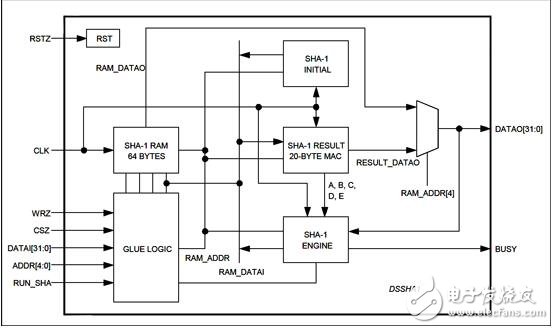
Figure1 shows the DSSHA1 block diagram. Table 1 describes the signals that connect the DSSHA1 to the host system. Using the data bus input, address, and control signals, the 64-byte SHA-1 message is inserted into the RAM. Triggering the input signal RUN_SHA to logic-high starts the SHA-1 computation. The output BUSY signal indicates an occurring computation. Upon completion of the BUSY signal, the result registers contain the 20-byte message digest for reading.
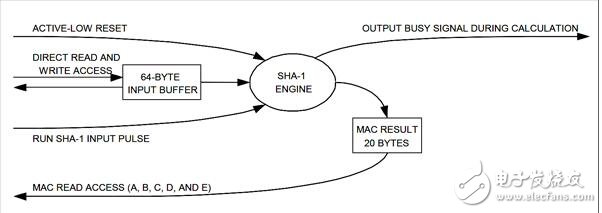
The DSSHA1 performs the job of a SHA-1 engine. The input buffer accepts the message. The MAC output buffer receives the resultant SHA-1 computation. Figure 2 illustrates data flow into and out of the SHA-1 engine.
Applying a power reset initiates the first step of using the SHA-1 engine. Next, a message is loaded into the input buffer in the format of Table 3. Upon completion of a message load, the user pulses the RUN_SHA input signal. For the duration of the SHA-1 computation, the BUSY signal goes and remains logic-high. A BUSY signal goes logic-low again when the SHA-1 computation completes. All five of the MRR registers (see Table 4) contain the MAC result for reading.
声明:本文内容及配图由入驻作者撰写或者入驻合作网站授权转载。文章观点仅代表作者本人,不代表电子发烧友网立场。文章及其配图仅供工程师学习之用,如有内容侵权或者其他违规问题,请联系本站处理。 举报投诉
- 相关下载
- 相关文章